
 Given its tumultuous rise to world prominence over a period of less than two centuries, it is no surprise that the history of political parties in the United States is equally effervescent. There has been a continuous and contradictory process of rise and fall, development, decay, and renewal of economic possibilities and interests, which is also expressed in politics. Today’s dominant parties have not always had their current grip on political power, and there have not always been just two major parties. At various times, third, and even fourth viable parties have emerged, sometimes succeeding in supplanting the parties of the day, sometimes appearing as just a blip in US history. What does the United States’ history of political parties tell us about the potential future political developments?
US History
BROWSE ARTICLES BY CATEGORY:
On the Program of the Black Panther Party: Which Way Forward for Black Workers and Youth?
By analyzing the program of the Black Panther Party, many lessons can be learned which can be applied in today’s struggle against capitalist exploitation and oppression.
100 Years Since the Ludlow Massacre of Striking Miners in Colorado
 100 years ago, US mining magnate John D. Rockefeller, with the help of the Colorado state government, ordered Colorado National Guard and militia forces to machine gun on a mining camp where 1,200 striking coal miners and their families were residing. Up to 60 people were killed and hundreds injured. The strikers were mainly immigrants who were paid slave wages by the company. They were forced to work 10–12 hour days and were not paid for “dead work” such as clearing the mines of rubble. The event marked a key milestone for America’s working class struggle to gain workplace rights, including the 8-hour work day, workplace health and safety measures, better housing, and the right to form a union.
The Life and Times of Pete Seeger (1919–2014)
We lost a spirited voice of the oppressed and exploited January 27, as Pete Seeger drew his last breath. Having reached the age of 94, Seeger had lived, fought, and sung through several tumultuous periods of ebb and flow of the class struggle over many decades.
The Class Struggle and the American Working Class
 We republish here the Introduction to the first Urdu edition of Marxism and the USA. The book has been translated by the Pakistani comrades of The Struggle and will be launched the coming congress of the The Struggle in March.
The Dynamic History of U.S. Political Parties and Tendencies
 The following interview, conducted in October 2012 by journalist Arash Azizi, was originally published in the Farsi-language journal Mehrnameh, the leading journal of humanities in Iran. In it, John Peterson gives a basic overview of the history of political parties and class interests in the United States, which shows that the U.S. political spectrum has not always been “the same,” and that things can and do change, often dramatically.
Texas' History of Class Struggle (Part 2)
This article is a continuation of Texas’ History of Class Struggle (Part 1).
Remembering "Bloody Friday"
 We are living in a tumultuous period of class struggle, characterized by the political reawakening of previously “apathetic” layers of society, and revolutionary upheaval around the world…Class struggle inevitably leads at a certain stage to open conflict. The role of the police force and the military are to protect private property and profits no matter what the cost, even if the cost is human lives…This is nothing new, and we need to look no further than the 1934 strike of Teamsters Local 574 in Minneapolis, Minnesota.
The 1960s: Lessons for Today
The period of the 1960s and early 1970s was one of upheaval around the world. The USA was not exempt from these powerful social movements.
Class Struggle and the American Revolution
Most historians present a caricatured version of the American Revolution; in reality, it was a bourgeois democratic revolution on a scale never before seen in history.
A Brief History of the MN Farmer-Labor Party
Minnesota’s Farmer-Labor Party was the most successful labor party in United States history. Starting in 1918, it was a labor party in the true sense, not just a “pro-labor” party.
Lessons of the Early CPUSA
Soon after the Russian Revolution in 1917, thousands of American workers and youth wanted to establish a workers’ government in the US. The subsequent founding of the CPUSA contains many lessons for revolutionaries today.
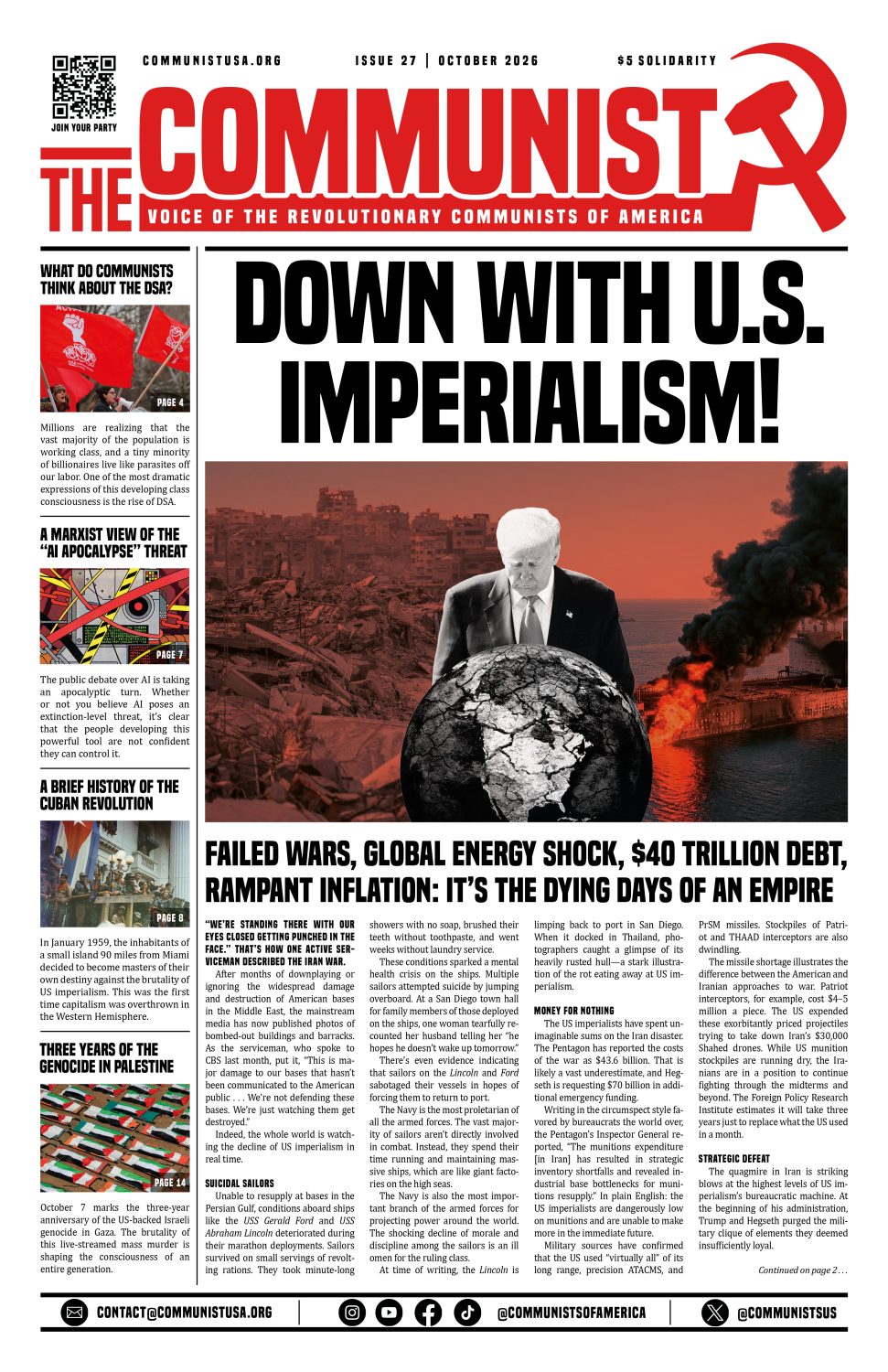
The Communist: The Voice of America’s Communist Generation
The Communist is the official newspaper of the party of the Revolutionary Communists of America. It is different from any other publication you’ll find in the US today. Behind this newspaper, there’s a vast network of communist activity from coast to coast. It is a tool for organizing in the streets, at protests and strikes, for building communist cells in our neighborhoods, workplaces, and campuses.
The RCA is on a mission to carry Bolshevism into the political arena of a country that’s ripe for it. Yes, we’re Bolsheviks living in the digital age, and we also use social media and our podcast to spread the communist program. But we’re not the kind of internet leftists who stay inside and “do politics” online. That’s why we need something we can carry with us into the streets and put into people’s hands. The physical paper is an instrument for building a real-life organization—a genuine Communist Party of fighters.