
The Shays uprising was just one of many outbursts of the class struggle that helped shape early American history. It had a powerful effect on what was to become the U.S. Constitution.
US History
BROWSE ARTICLES BY CATEGORY:
When the Socialist Party Was a Factor in US Politics: Lessons in Party Building
In this article, the conditions for socialist revolution are analyzed, looking at the experience of the Socialist Party of America.
The 75th Anniversary of the 1934 Minneapolis Teamsters Strike (Part 2)
 After a bitter coal yard workers’ strike and organizing campaign in early 1934, Teamsters Local 574 won the right to represent thousands of workers in Minneapolis. But by May, a second strike became necessary, after the trucking and warehouse bosses refused to recognize the local. See Socialist Appeal 48 or visit our website for part 1 of this article.
The History of Labor Day
 Every year, workers across the United States celebrate Labor Day on the first Monday of September. It is seen as a marker of the end of Summer, the start of football season, and the return to school for millions of students. But what is the origin of this holiday? What is its relation to the internationally celebrated Labor Day on May 1st?
The 75th Anniversary of the 1934 Minneapolis Teamsters Strike
The 1934 Teamsters strike in Minneapolis was a decisive moment in the US labor and socialist movements.
Engels Letter on the Need for a US Labor Party
The following letter from Frederick Engels shows his perspective for the development of a labor party in the United States and the way that Marxists should orient to such a party.
Prospects for a Labor Party
In every major country, the working class has built political parties to combat the capitalists in the political arena, with one exception: the working class in the United States has not yet built its own political party.
The Declaration of Independence
Originally the majority of the upper class Americans did not want independence. But the mood of the masses made all thought of compromise impossible. On July 4, 1776, the Thirteen United States of America declared their independence from Great Britain.
Black Struggle and the Socialist Revolution
This document was passed at the 2008 National Congress of the US Section of the IMT. To fight racism, we must fight capitalism!
Shays’ Rebellion
The challenge thrown down by Shays terrified the oligarchy that was quietly concentrating political and economic power into its own hands.
America After 1945 and McCarthyism
Originally published in the book Marxism and the USA, published by and available from Wellred.
 On February 9, 1950 Senator Joseph R. McCarthy of Wisconsin claimed that there were no fewer than two hundred Communists in the State Department. This outrageous allegation unleashed a witch-hunt against everyone who was even slightly “tainted” with left wing, progressive or even vaguely democratic opinions in public life. The hysteria that accompanied this campaign closely resembled the kind of pathological collective hysteria of the notorious Salem witch trials of the 17th century.
The Workers' Uprising of 1877

 This was the period of the most violent labor conflicts in the history of the United States. The first of these occurred with the Great Rail Strike of 1877, when rail workers across the nation went out on strike in response to a 10-percent pay cut. A contemporary labor paper called the Great Strike the beginning of a Second American Revolution. Originally published in the book Marxism and the USA, published by and available from Wellred.
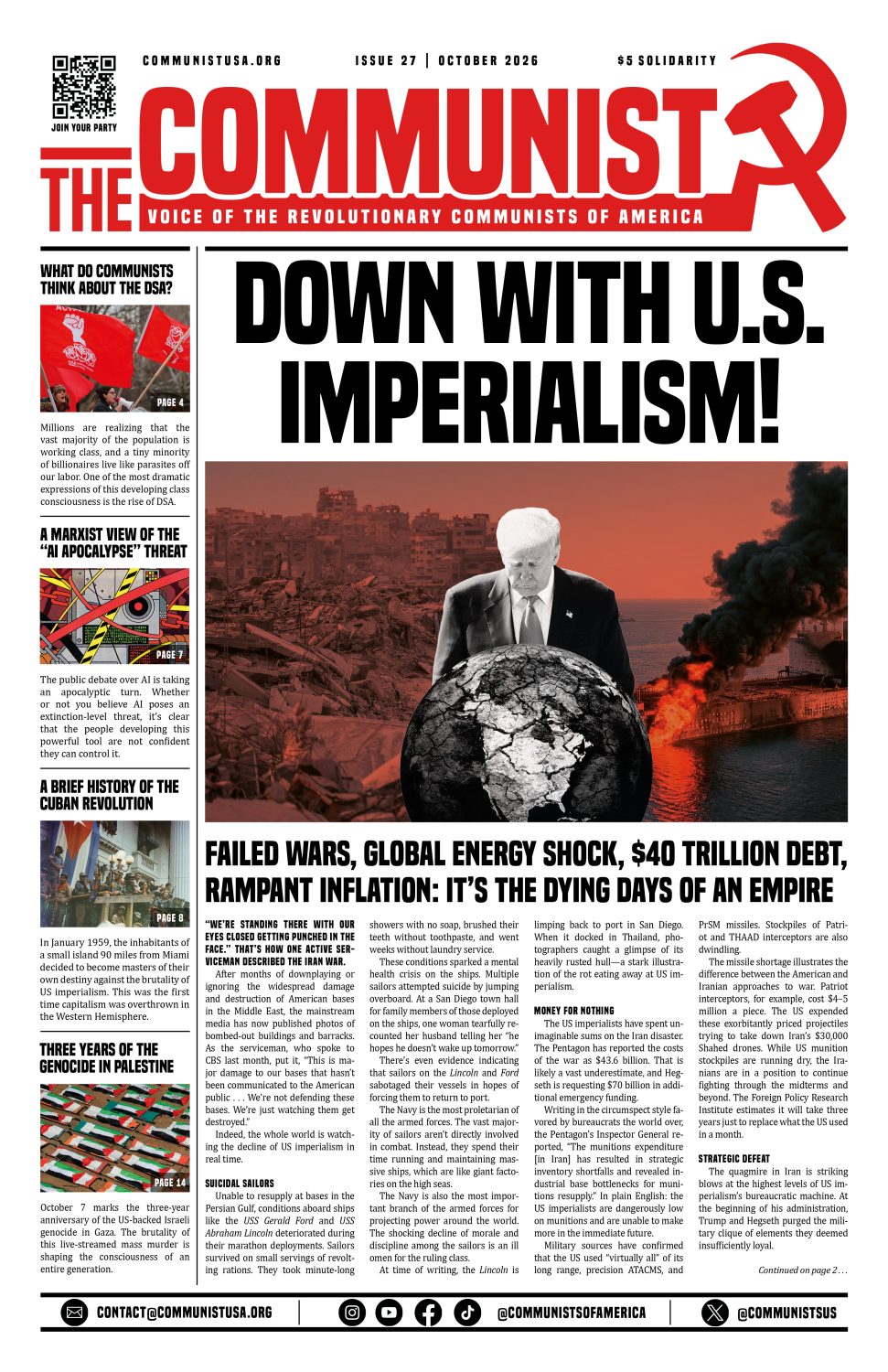
The Communist: The Voice of America’s Communist Generation
The Communist is the official newspaper of the party of the Revolutionary Communists of America. It is different from any other publication you’ll find in the US today. Behind this newspaper, there’s a vast network of communist activity from coast to coast. It is a tool for organizing in the streets, at protests and strikes, for building communist cells in our neighborhoods, workplaces, and campuses.
The RCA is on a mission to carry Bolshevism into the political arena of a country that’s ripe for it. Yes, we’re Bolsheviks living in the digital age, and we also use social media and our podcast to spread the communist program. But we’re not the kind of internet leftists who stay inside and “do politics” online. That’s why we need something we can carry with us into the streets and put into people’s hands. The physical paper is an instrument for building a real-life organization—a genuine Communist Party of fighters.