

On January 1, 1959, the hated, US-backed dictatorship of Fulgencio Batista was overthrown by a guerrilla war, mass popular uprising, and national general strike.
Initially, Fidel Castro and the rest of the revolution’s leadership did not intend to advance toward socialism. In a visit to New York City that same year, Castro declared:
I have clearly and definitely stated that we are not Communists … The gates are open for private investment that contributes to the development of Cuba.
However, in 1960, he would return to New York to deliver a fiery speech at the General Assembly of the UN, where he proclaimed “the right of underdeveloped countries to nationalize, without compensation, their natural resources and monopolistic investments.”
By 1961, 80% of Cuba’s economy had been nationalized: the sugar mills and oil refineries, electricity and telephone, ports and railways—most of which belonged to the US. The big landed estates had been expropriated and given to the peasants.
Over one million people rallied in Havana in 1962, one year after defeating the CIA-backed invasion of Bay of Pigs. There, Fidel delivered the historic “Second Declaration of Havana”:
Cuba speaks for America’s exploited masses; the United States for the exploiting, oligarchical, and imperialist interests … Cuba for socialism! The US for capitalism … What Cuba can give to the people, and has already given, is its example. And what does the Cuban Revolution teach? That revolution is possible, that the people can make it.
That is the real reason the Cuban Revolution is seen as such a threat by US imperialism. The people of a small island with ten million inhabitants decided to become masters of their own destiny against the arrogant brutality of US imperialism.
This was the first and only time that capitalism was overthrown in the Western Hemisphere—and it was done just 90 miles off the coast of Florida. On the basis of a planned economy, the Revolution achieved miracles in the fields of healthcare, housing, employment, literacy, culture, and beyond. Above all, it set a precedent for the masses of Latin America and the world that the socialist revolution is not a pipe dream.
The heroic survival of the Cuban Revolution is a daily reminder to US imperialism of its humiliating defeat. For 64 years, the US government tried—and failed—to crush it through sabotage, coups, assassination attempts, terrorist attacks, and a criminal blockade. Isolated, surrounded, and under constant assault from the most reactionary imperialist power in history, the Cuban masses have overcome incredible hardship to defend the gains of 1959.
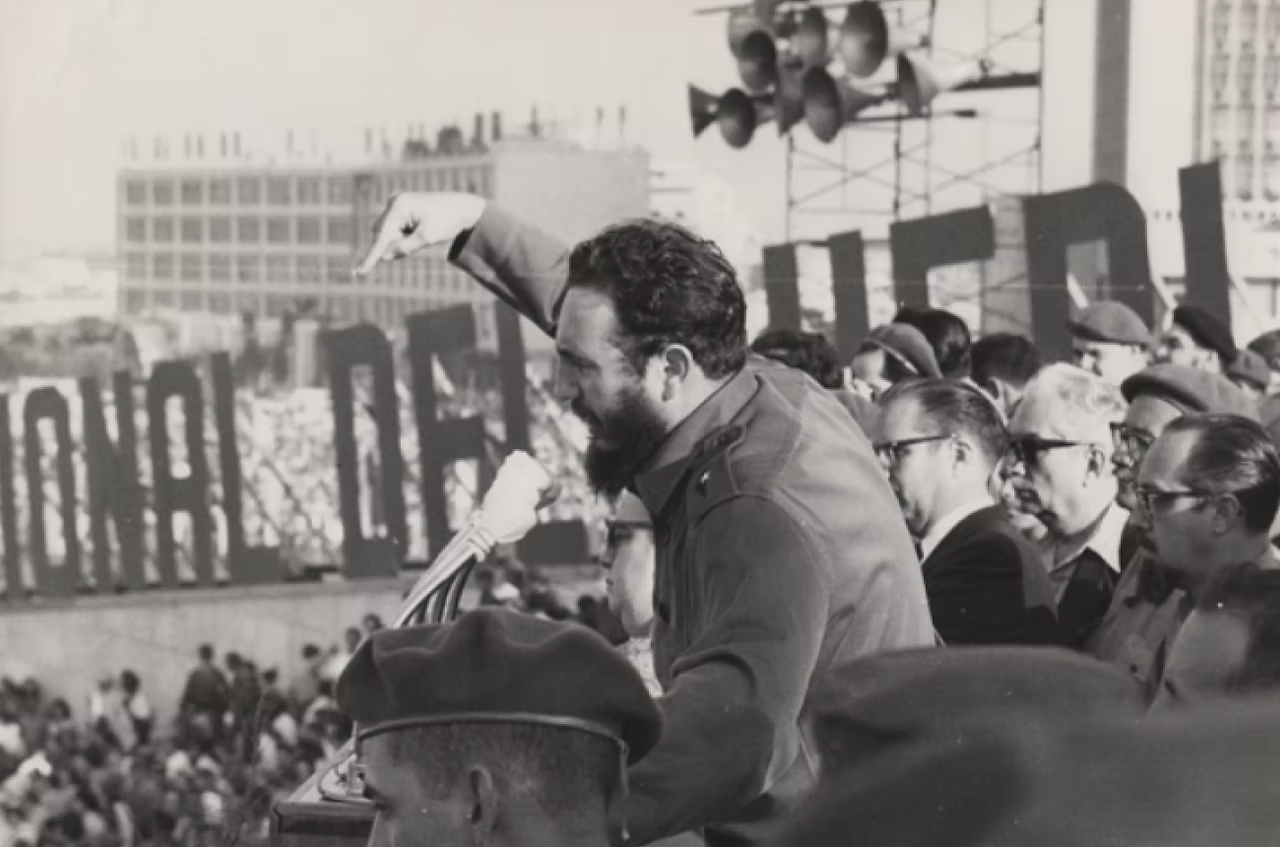
“Cuba speaks for America’s exploited masses; the United States for the exploiting, oligarchical, and imperialist interests … Cuba for socialism! The US for capitalism …” / Image: public domain
US imperialism’s obsession with Cuba
Today, the Revolution is facing its most serious danger. Considering the brutal history of US intervention, that’s saying a lot.
As early as 1960, a secret memorandum by Deputy Assistant Secretary of State Lestor Mallory bluntly explained that the Revolution had too much support within the island to achieve a quick victory via invasion or coup. Therefore, the only effective way to undermine and overthrow it would be to create “disaffection based on economic dissatisfaction and hardship,” that is, “denying money and supplies to Cuba, to decrease monetary and real wages, to bring about hunger, desperation, and overthrow the government.”
Donald Trump’s and Marco Rubio’s siege of the island is the culmination of this decades-long effort. The US government is engineering a humanitarian catastrophe, designed to maximize suffering and force Cuba’s surrender at gunpoint.
“It’s a failed nation. They have no oil, they have no nothing,” said Trump in March 2026. After imposing a total oil blockade, the US imperialists have the audacity to criticize Cuba for lacking fuel! He continued: “I think I’ll be having the honor of taking Cuba.” Thus, the president is verbalizing what has been US policy for over 200 years.
As early as 1820, Thomas Jefferson said that he “looked on Cuba as the most interesting addition which could ever be made to our system of States,” and that the US “ought, at the first possible opportunity, to take Cuba.”
In 1823, after the Monroe Doctrine was proclaimed, then–Secretary of State John Quincy Adams compared Cuba to a ripe apple that would fall from the tree of the Spanish Empire and naturally gravitate into the hands of the US. In case the metaphor wasn’t clear enough, he also translated it into plain prose:
[Cuba] has become an object of transcendent importance to the political and commercial interests of our Union … The annexation of Cuba to our federal republic will be indispensable to the continuance and integrity of the Union itself.
Cuba became a Spanish colony in 1511, and was the last colony in the Americas to gain independence from the Spanish Empire in 1898. But already in the 1850s, the US had emerged as Cuba’s largest trading partner, importing sugar, tobacco, and coffee and exporting manufactured goods to the island.
At the time, Cuba was a slave plantation economy based on large agricultural estates, or latifundia, producing a third of the world’s sugar. Black slaves made up about 45% of the population, and freed slaves another 13%. Cuba also has large reserves of nickel, as well as iron, copper, manganese, chrome, and tungsten—key raw materials for industrial production.
Given its strategic importance, the US made three offers to purchase Cuba outright in 1848–54, but Spain refused. The Cuban bourgeoisie largely favored these offers, anticipating the role these comprador capitalists would play during the Revolution.
By the 1890s, the United States owned many key sectors of Cuba’s economy, including electricity, the telephone exchange, and most of the island’s sugar mills. 90% of Cuban sugar exports went back into the US market.
As US Secretary of State James Blaine said in 1881:
That rich island, the key to the Gulf of Mexico, and the field for our most extended trade in the Western Hemisphere is, though in the hands of Spain, a part of the American commercial system … If ever ceasing to be Spanish, Cuba must necessarily become American.
The rising US capitalist class ensured that it would be so.
Cuban independence and the Spanish-American War
The Cuban struggle for independence from Spain was a long, violent process, led by the Cuban radical petty bourgeoisie, and fought by the peasants and poor. It opened with the 1868 uprising of de Céspedes, who freed his slaves and launched an armed struggle remembered as the Ten-Year War; and continued with the 1895 War of Independence led by the legendary José Martí, who was killed in battle that year.
The US government and media spoke of the need to “help poor Cuba” against the abuses of Spain—which were many and indeed very brutal. US imperialism’s aim, however, was to use the excuse of “democracy” to swoop in and take the island for itself. After three decades of conflict and mutual exhaustion between the Cuban rebel troops (known as mambises) and the Spanish army, the US finally declared war on Spain in 1898. The US military defeated the outmatched forces of the declining Spanish empire within six weeks in what became known as the Spanish-American War.
Immediately, the US forces disarmed the Cuban independence fighters and established a dictatorship. The Americans ruled Cuba through a military government until 1901. At gunpoint, with the US Marines off its shores, the Cubans were forced to incorporate the Platt Amendment into their constitution, adopted that year.
Although the island would become formally “independent” in 1902, the Platt Amendment:
- Gave the US the right to militarily and politically intervene in Cuba at any time.
- Prohibited Cuba from associating with other countries unless the US approved of it.
- Gave Cuban sugar preferential access to the US market, which guaranteed handsome profits to American owners of sugar plantations like the United Fruit Corporation.
- Gave US exports preferential access to the Cuban market.
- Ceded Cuban land for use by the US military.
- The US set up its base on Guantánamo Bay in 1903. It remains on the island to this day, with its infamous detention center where all manner of abuses and torture take place in American-occupied Cuban territory.
Cuba became an owned subsidiary of US businesses producing sugar and tobacco with cheap seasonal labor. The US could veto or overturn any decision of the Cuban government. For the following six decades, the Americans completely dominated Cuban politics, dispatching troops to the island no fewer than four times to “keep order” and install new governments.
US-sponsored dictatorships
The American ruling class and its media accuse post-1959 Cuba of being a “dictatorship” without “freedom” or “democracy.” This is a cynical lie. And besides, who is the US government to complain about dictatorship? US imperialism has been the number one sponsor of terrorism worldwide for at least 80 years. It has launched and bankrolled endless wars, bombed civilians indiscriminately, overthrown elected governments, and imposed dictatorships in Latin America and worldwide.
The history of prerevolutionary Cuba is essentially a continuous sequence of brutal regimes, all imposed by and doing the bidding of the imperialists.
In 1906–09, Roosevelt sent 2,000 Marines to Cuban shores and set up a provisional government headed by a US judge, Charles Magoon. Among other things, this US-appointed government helped to import American methods of racist terror and segregation, unleashing white vigilantes to kill Afro-Cubans. Lynched bodies were left hanging outside towns, or their severed heads placed on the side of railroad tracks.
In 1912 and again in 1917–20, the US Marines were sent again to crack down on big sugar strikes that severely threatened US profits. In 1921, Woodrow Wilson’s representative went to Havana to rewrite the election laws so he could basically hand-pick the next government.
In 1933, the American Atlantic Fleet and Marines landed again in response to an insurrectionary general strike in the island. The US ambassador organized a new pro-US government, but it was so weak and unpopular that it lasted a single month.
Grau San Martín’s “100 Days Government” followed, representing radicalized petty-bourgeois layers. Grau was forced to resign by the head of the army, Fulgencio Batista, who had been conspiring with US Ambassador Jefferson Caffery. Between 1934 and 1959, Batista ran the show in Cuba as an agent of imperialism—sometimes behind the scenes with puppet presidents, and twice as head of the government.
Cuba before the revolution
Let’s look at some examples of the kinds of “democratic” methods the dictator Batista employed on behalf of US capitalism.
Batista responded to a strike wave in 1934–35 by suspending the constitution, imposing martial law, and banning all free speech. The unions were dissolved, strike leaders abducted and assassinated; the university, an important center of struggle, was closed down and militarily occupied for three years; strikers were arrested en masse and civilians executed by firing squad.
After raiding the Cuban treasury, Batista fled the island in 1944 and went into “retirement” in Florida. When the US requested his services again in 1952, he returned to run for president. The polls showed him coming in a poor third, so he simply mobilized the army again and sent the tanks to the presidential palace, setting up yet another bloody dictatorial regime.
In his seven years of rule between 1952 and 1959, the regime murdered over 20,000 people. Any and all Cubans who dissented with the government would be persecuted, taken into custody, beaten, tortured, disappeared, or their dead bodies dumped by the roadside. The police, army, Rural Guard, and death squads killed and raped almost at will.
Many Cubans lived in a state of absolute destitution. In good years, 20% of the workforce was unemployed. The 500,000 sugar cane workers made up a quarter of Cuba’s total working population, but they were seasonal laborers who, after four months of work, would be unemployed for the rest of the year.
A quarter of the population was illiterate, and in many rural areas the rate was over 90%. Only 15% of urban housing had bathrooms. Land ownership was massively unequal: 2% of the population owned 50% of the farm land. In the countryside, a majority of peasants lived in huts with palm roofs and bare dirt floors, without water or electricity. Only 4% of peasants had access to meat and 2% to eggs.
Conditions for women were even worse in what had been a Catholic-dominated, economically backward country. Fewer than 10% of urban women worked outside the home. Many women resorted to working as servants for the rich—or to prostitution—just to survive.
In the 1950s, Cuba had become an Epstein island; a sort of private brothel-casino for the enjoyment of the depraved US ruling class. The mafia controlled all the casinos, many hotels, and the sex industry. The drug trade and child prostitution were unrestricted, with thousands of children kidnapped and sold into sex slavery.
Two anecdotes provide a glimpse into the kinds of atrocities that shaped the outlook of the generation of fighters that carried out the Cuban Revolution in 1956–59.
Celia Sánchez was a nurse and receptionist for her father, a famous progressive doctor. She became very attached to the daughter of a peasant her dad was treating. Celia treated this ten-year-old girl as a daughter. The girl suddenly went missing. A few days later, they found her body in the basement of a high-end casino—abused and killed for the pleasure of some American who had requested a girl for the night.
From that point on, Celia Sánchez became a resolute fighter against Batista. She was one of the earliest members of Fidel Castro’s group and became a top leader, in many ways equal to Fidel himself, as well as the first woman to join the Rebel Army in April 1957.

Celia Sánchez / Image: public domain
As the Rebel Army advanced in the countryside, recruiting local peasants, Batista responded by bombing entire villages, whether guerrilla fighters lived there or not. The regime carried out indiscriminate massacres of innocent men, women, and children. This included the use of napalm, which the US had supplied to Batista. Witnessing this horror, Fidel Castro wrote to Celia Sánchez in 1958:
I swore to myself that the North Americans were going to pay dearly for what they are doing. When the war is over, a much wider and bigger war will commence for me: the war I am going to wage against them. I am aware that this is my true destiny.
Fidel and the M-26J
Fidel was a tall, athletic, and charismatic young man. A petty-bourgeois radical, he became a popular student leader in his university years. As a lawyer in Havana, he would often take the cases of poor people who often couldn’t pay for his services. He had run as a candidate for congress in a petty-bourgeois party known as the Ortodoxos in 1952. He would probably have won the election, but Batista’s coup thwarted the effort. Thus, he reached the conclusion that the only way to gain power was through a revolution.
On July 26, 1953, he led a group of around 130 in an armed insurrection to take an army barracks in Santiago de Cuba. From this point on, the organization would be known as the July 26 Movement (Movimiento 26 de Julio; M-26J or M-26-7 for short). Their aim was to spark a nationwide insurrection that would overthrow the Batista regime. But this was a small, petty-bourgeois group with no mass base and no links to the workers and peasants. Their attempt ended in disaster. Eight were killed by Batista’s troops, the rest were captured, and 80 more executed as retribution. An indiscriminate wave of government repression followed, with 100 more students, trade unionists, and socialists arrested.
Despite the failure, to their credit, Fidel and his crew were brave, committed fighters who stood their ground. As a lawyer, Castro took on the defense of all those accused, and only a quarter of the cases ended in conviction. He used the trials as a platform to deliver his historic speech, “History Will Absolve Me,” where he condemned the Batista regime and defended the “right of insurrection against tyranny.” This would later be published and become the manifesto of Castroism.
Fidel and his group became famous and respected throughout Cuba due to their revolutionary determination. Popular support was such that by 1955, the prisoners were amnestied and released. The founding meeting of the M-26J took place in June of that year. Shortly after, Fidel and his brother Raúl Castro traveled to Mexico with other leaders. It is in Mexico City that they met Che Guevara, who would join them till the end. Other leading M-26J members stayed in Cuba to run the urban underground, including Frank País, Celia Sánchez, Haydée Santamaría, and Armando Hart.
The M-26J had a radical program of democratic demands, national liberation, and agrarian reform, i.e., breaking up the latifundia and giving land to the peasants. They wanted to bring back Cuba’s 1940 constitution, which, among other things, included pro-worker provisions, such as guaranteed employment, shorter working hours, etc. They defended the right of workers to a bigger share of company profits. The program also espoused the ideals of “Jeffersonian democracy,” and of reaching a “state of solidarity and harmony between capital and workers to raise the country’s productivity.”
This was, therefore, not a socialist program, but rather, a progressive national-democratic program. Above all, they consistently demanded the revolutionary overthrow of the dictatorship. Their refusal to compromise on this point won them mass support. In Fidel’s words from 1956:
The 26th of July Movement is the revolutionary organization of, by, and for the common people … [A movement] without sugar barons … without stock-market speculators, without magnates of industry and commerce, without lawyers for big interests, without the provincial political bosses … The 26th of July Movement is the hope of redemption for the Cuban working class … It is the hope of land for the peasants who live like pariahs in the country that their grandfathers liberated … It is the hope of bread for the hungry and of justice for the forgotten.
The theory of permanent revolution
In the 1950s, the United States owned 90% of Cuba’s mines and cattle ranches; 80% of the public utilities; 50% of the railways; and 40% of Cuba’s sugar land, producing about half of all crops.
As a result, even seemingly reasonable, national-democratic reforms clashed directly with US capitalist interests. A New York Times article from April 1959 clearly articulated this, while expressing the ruling class’s worries at the prospect of losing control of Cuba:
Cuba not only supplies 40% of the sugar we consume, she is the repository of something like $800,000,000 worth of American investments. A glance at the map is enough to show the strategic importance of the island. It lies astride all the sea and air approaches to the United States from the south. Our naval base in Guantanamo Bay is the key base in the Caribbean area. Fidel Castro himself is of great importance to us. The masses of Latin America see him as the outstanding champion of the social justice for which they are striving. As a friend of the United States he could be very helpful; as an enemy he could be very harmful.
For its part, the tightly knit alliance of Cuban landlords and bourgeois was very weak and completely dependent on the US. Their own wealth and privileges were based on imperialist domination of the island. They had no intention of carrying through the tasks of the bourgeois revolution, because this would have dealt a mortal blow to their own interests. In fact, most of the Cuban oligarchy favored annexation by the US!
There was no “progressive bourgeoisie” in 1950s Cuba that could take up the banner of the democratic revolution and independence. This role would fall on the working class, in alliance with the peasantry. As Trotsky explained, and Russia’s October Revolution proved, the revolution would start with the national-democratic tasks, but these could be fully achieved only if it went beyond the limits of capitalism, as a first step toward world socialist revolution.
Within Cuba, few people understood this. Julio Antonio Mella was one of them. Mella was a radical student leader in the Federación Estudiantil Universitaria in Havana. He was one of the founders of the first iteration of the Communist Party of Cuba, in 1925. He wrote in 1928:
In their struggle against imperialism (the foreign thief), the bourgeoisies (the national thieves) unite with the proletariat, the good old cannon fodder. But they end up realizing that it is better to form an alliance with imperialism, which at the end of the day pursues similar interests.
That was the position of the Leninist Communist International in that period. Later on, the official, Stalinized Communist Parties in Latin America broke with this conception and adopted the Menshevik “two-stage theory.” Stalin argued that colonial and semi-colonial countries required a national-democratic revolution and a separate capitalist stage of development before the question of socialism could be posed. That stage had to be led by the progressive bourgeoisie, and the workers were meant to support it and not raise any socialist demands. No longer defending the revolutionary internationalist principles of Lenin and Trotsky, these parties now served the foreign policy needs of the Moscow bureaucracy, which claimed to be building “socialism in one country.”
In the search for a non-existent “progressive” Cuban bourgeoisie, the Cuban Communist Party allied with… Fulgencio Batista! This was a “popular front” with a reactionary dictator and with US imperialism itself. In exchange, Batista rewarded the Party with legality in 1939. Shamefully, the “Communists” participated in his government with two ministers, several seats in the Cuban Congress, and the leadership of the main trade union confederation. For this treacherous collaboration, which continued until the early 1950s, communism would be severely discredited in the eyes of the Cuban revolutionary vanguard.
Unlike Mella, the Argentinian doctor Che Guevara was no Marxist theoretician, yet he was a very honest, self-sacrificing revolutionary. On the basis of his own experience in the Cuban Revolution, he also found his way toward a revolutionary, proletarian-internationalist position. In his “Two, Three, Many Vietnams” message to the 1966 Tricontinental Conference, he correctly explained:
The native bourgeoisies have lost all their capacity to oppose imperialism—if they ever had it—and they have become the last card in the pack. There are no other alternatives; either a socialist revolution or a make-believe revolution.
A working-class struggle
Cuba had a sizable, militant working class, especially the sugar cane laborers, but also in the urban centers. So the national struggle for Cuban liberation was always deeply intertwined with the social struggle.
Throughout the 1910s and 20s, many agricultural workers emigrated from Spain, bringing with them their traditions of class-struggle unionism and anarchism. This period saw big strikes in the sugar mills, tobacco, transportation, ports, universities, etc. The Great Depression of the 1930s hit the Cuban economy hard, sparking another wave of class struggle that developed into an insurrectionary general strike in August 1933.
In September 1933, 36 sugar mills were under workers’ control through revolutionary councils, and workers’ and peasants’ patrols kept order like a red militia, often fraternizing with soldiers. A byproduct of this struggle was the removal of the Platt Amendment from the Cuban Constitution, in 1934. Although largely symbolic—Cuba remained a semi-colony of the US—this was a big victory that reveals the power of mass, working-class struggle in forcing concrete concessions from imperialism.
Social explosions continued in the postwar period, with strikes involving hard pickets, street battles with barricades, occupations, derailment of trains carrying troops, the burning of bridges to impede transport, etc.
This must be highlighted because most accounts of the Cuban Revolution focus solely on the role of the armed guerrilla struggle in the countryside. The truth is that the masses of peasants and workers played a decisive role before, during, and after the Revolution.
The M-26J itself set up a workers’ section to coordinate activities among workers in the cities. The main base of the movement at the beginning was among workers in the urban underground. Over time, dozens of workplace cells were set up, and this also had an impact on the communist youth, some of whom began to look to Castro’s people as a serious pole of attraction.

Fidel Castro and his guerrilla in the Sierra Maestra. / Public Domain
The revolutionary overthrow of Batista
The plan for the Revolution was that the first guerrilla troops would disembark from Mexico to Cuba in December 1956, aboard the famous Granma boat. The 82 insurgents—including Fidel and Raúl Castro, Che Guevara, and Camilo Cienfuegos—arrived late and at the wrong location, with Batista’s troops waiting for them. By the time they reached the camp in the Sierra Maestra—the mountain range in Santiago de Cuba—only 16 of them were left, with a grand total of 12 guns.
Over time, they were able to regroup and train fresh recruits from the cities. Little by little, they raided isolated garrisons, seizing new weapons. Through their program of land redistribution, they succeeded in growing stronger ties with the local peasants. They also won their trust by teaching them to read and write, and providing medical services.
The guerrillas became a focal point, but the decisive factor was that the Cuban masses were ready to get rid of a regime that everybody hated. The assassination of the second main leader of the M-26J, Frank País, demonstrates the ripeness of the situation. País headed up the workers’ section, and upon his killing by secret police, a general strike shut down Santiago and spread to other cities. His funeral became a mass demonstration of 60,000.
The workers, as well as students and discontented petty bourgeois supported a revolution. In the absence of a genuinely Marxist revolutionary leadership, they placed their hopes in the guerrillas, waiting for a military defeat of the Batista regime on that basis. The balance of struggle shifted from the cities to the countryside, and land reform became the banner of the guerrilla struggle, together with an end to hunger and Batista’s killings.
The regime was weak; the ranks of the armed forces, made up of conscripted workers and poor peasants, were demoralized, hungry, and lacked training. Against a determined enemy fighting for the oppressed majority, they were looking to surrender rather than fight. As the guerrilla’s front expanded and won more battles, support multiplied. For example, Che’s column of 230 grew tenfold as it marched toward the central city of Santa Clara.
Che’s forces captured Santa Clara on December 31, 1958, as Fidel’s guerrilla won key battles descending from the Sierra toward Santiago, in the far east of the island. Facing defeat, Batista fled after setting up a provisional government in an attempt to rearrange the deck chairs. But this time, it was too little, too late.
At 2 a.m. on New Year’s Day, 1959, Fidel Castro delivered a speech on the guerrilla’s radio station Radio Rebelde with a clear message: “Revolution yes! Military coup no!” He called on all workers to seize their union offices and bring their workplaces to a standstill. Everything stopped. A completely successful national general strike lasting from January 1 to January 4 ensured the success of the revolution.

The guerrillas became a focal point, but the decisive factor was that the Cuban masses were ready to get rid of a regime that everybody hated. / Image: public domain
First year in power
The M-26J had come to power as the result of a revolutionary mass insurrection that destroyed the political power of the bourgeoisie and smashed the state apparatus. The guerrilla army took over all military posts and police stations, and became the new administrative apparatus throughout Cuba.
The US capitalist media and Miami gusanos—descendants of the Cuban oligarchy that fled the island—play up the revolutionary violence to this day. Initially, executions of the worst of Batista’s military butchers took place by firing squad. Then, public trials were held before mass popular juries. In total, a mere 600 of Batista’s henchmen were executed—a small figure compared to the tens of thousands jailed, tortured, and murdered by the regime. In the frank words of the head of the CIA at the time: “There were many instances of cruelty and repression by Batista’s army … now there will probably be a lot of justice.”
The first government after the Revolution was a coalition based on the 1940 Constitution. The cabinet included mostly liberal elements, such as professors and lawyers, many of whom were staunch anticommunists. Of the 25 cabinet members, only three came from the guerrilla army.
At this time, Fidel intended to placate US imperialism by showing moderation. He went on a tour of the US, courting investment and trying to make it clear that his was a democratic, not socialist, revolution. In May 1959, he proclaimed:
Our revolution is neither capitalist nor communist! … Our revolution is not red, but olive green. It bears the color of the rebel army from the Sierra Maestra.
However, it quickly became clear that the new petty-bourgeois government had no intention of actually carrying out the Revolution’s program, especially on the key question of agrarian reform. The guerrillas, who were men of action and expected immediate measures, grew impatient at the government’s inaction, as Fidel described in a televised address in December 1961:
In the hands of the ruling class at this moment were: all the financial resources, all the economic resources, the entire press … all the big radio and television stations … they were, to put it simply, still the owners of the country … The responsibility for making revolutionary laws was in their hands … We waited to see what would happen … The weeks went by and they had not passed a single revolutionary law.
Why was this? Because to satisfy the demands of the masses, the government needed to encroach on private property and capitalist profits, including US imperialism’s. This would go counter to their own class interests.
Within a month, the prime minister resigned and Fidel Castro replaced him. In March and April, the government implemented much of Fidel’s program of reforms, which included:
- Reduction of rents and mortgage rates.
- Landlords were forbidden from evicting tenants.
- Minimum wage for sugarcane cutters, pay rises for the lower-paid civil servants, and pay cuts for the tops.
- 30% reduction of electricity costs and 50% of phone rates (which were US-owned).
- Infrastructure programs such as building new bridges, allowing access to isolated villages.
- Antidiscrimination measures, such as ending whites-only facilities.
These were relatively moderate, progressive measures, but they threatened capitalist profits. The US ruling class became uneasy. Throughout Latin America, they had seen many governments come and go, and sooner or later, they all capitulated to imperialist diktats. This was something new: in Cuba, they actually seemed to be carrying out what they had promised.
The key turning point was the Agrarian Reform Law announced in May 1959 under the slogan of “Those who work the land shall own it”:
- Large estates of over 1,000 acres were to be expropriated and distributed to the peasants as cooperatives.
- The property of Batista’s people would be expropriated outright, with few exceptions.
- Lands could only be inherited or sold directly to the state, to prevent the emergence of new large estates.
- Landowners to be compensated with 20-year bonds at 4% interest, equivalent to the owners’ own valuation submitted for tax purposes.
Unsurprisingly, the United Fruit Corporation rejected this offer, with the support of the US government. Implementing the new laws would mean a head-on confrontation with imperialism.
At this point, the role of the individual became decisive. There are countless examples of petty-bourgeois or reformist leaders who come to power with the best of intentions, but cave under the pressure of imperialism and its local lackeys. By confining themselves to capitalist limits, they must reassess their program, come up with “realistic,” “implementable” goals, and betray the movement.
The Cuban Revolution, under the leadership of Fidel Castro and Che Guevara, did not retreat. The president, Urrutia, was forced to resign. Faced with a political crisis in the cabinet, they leaned on mass mobilization instead, and moved decisively to the left to give land to the peasants and expropriate the parasitic landowners.
Tit-for-tat nationalizations
In response, the US escalated its offensive against the revolutionary government. But at each step, the Cuban government retaliated in kind.
Throughout 1959–60, the CIA funded and trained reactionary gangs that carried out attacks against Castroists and various forms of sabotage: aerial attacks, burning crops and warehouses, killing farm animals, destroying the telephone exchanges, etc.
So the Revolution responded by seizing all possessions and property of persons convicted of counterrevolutionary activities and those conspiring from abroad. To counter the intensifying aggression, the government also expanded local rank-and-file initiatives of armed workers’ militias into a National Revolutionary Militia.
In 1960, the USSR sent 300,000 tons of crude oil to Cuba, but the US-owned Shell, StandardOil, and Texaco refineries within the island refused to process it. In response, the Cuban government placed the refineries under its supervision.
In July 1960, US President Eisenhower pulled the plug on the sugar quota, effectively beginning the blockade. In response, the Cuban government nationalized US sugar properties. Showing his truly unique audacity, Fidel Castro declared:
In response to their attempt to take away our quota pound by pound, we will take away their sugar mills one by one, and we will take everything from them, cent by cent, until we’ve taken every last investment from the Americans.
In August 1960, he nationalized US-owned property: telephone, electricity, railways, ports, and 36 sugar refineries. A few months later, all American banks were nationalized, allowing Cuba to control its own finances through the state-run bank, led at that time by Che Guevara.
By October 1960, the property of those who fled the country was also nationalized, along with the largest Cuban companies. These Cuban corporations were completely reliant on US companies, so they could not function independently of the planned economy once US property had been seized. The Law for Urban Reform also expropriated the big landlords’ property, transferring housing ownership to the tenants. Zohran Mamdani could take a page from Fidel Castro’s book if he wants to meaningfully help tenants!
Thus, within just a few months, 80% of the economy was under the control of the Cuban state. This included the railroads, ports, banking, and 90% of export industries, meaning that foreign trade was fully under state control—an essential measure for the survival of the planned economy.
Workers’ state
The Cuban leaders did not have a worked-out plan to establish a workers’ and peasants’ government. They responded empirically, trying to solve problems as they arose. What was extraordinary is that, rather than backing down, they followed the only viable path to satisfy the needs of the masses and implement their program: expropriating capitalism. An urban leader of the M-26J and now Minister of Education, Armando Hart, explained in a 1960 interview with an American journalist:
United States policy is forcing us to make our revolution much faster than we wanted to. It is a stupid policy, because the reaction is always the contrary of what the United States wants. Communism was no problem here. If it is now, you created it by forcing us into policies for which we had no other choice.
Though unconsciously, this perfectly expresses the dynamics of the theory of permanent revolution.
This process also reveals a fundamental feature of this revolution. The political structure, carried over from military guerrilla methods, was of a top-down nature. The working class did not hold power directly through soviets or other workers’ or popular councils with decision-making power. Fidel Castro and a thin layer of other guerrilla leaders held all the main government posts, which were appointed. All the laws were decided from above and implemented by decree.
Cuba had become a workers’ state: capitalist property relations had been overthrown and replaced with a planned economy. But it was not a healthy workers’ state, based on workers’ control and management of the economy. A full transition to socialism would require workers’ democracy and, above all, for the revolution to spread to the rest of Latin America and the world.
That said, the Cuban leadership had overwhelming and enthusiastic popular support and authority—and not only in Cuba. This government better represented the will of the majority than any so-called bourgeois “democracy,” including in the US, with its two hated, ruling-class parties taking turns oppressing the population at home and funding imperialist wars abroad.
In Cuba, every advance of the Revolution was supported, encouraged, and legitimized through mass mobilization of the workers, peasants, and women, who were deeply loyal to the government. The revolutionary process unleashed spontaneous creativity and initiative from below. This was also expressed in the mass organizations of the Revolution.
Millions of people became involved in the trade union federation (under new leadership), the Student Federation, and the National Federation of Cuban Women. The new Communist Party of Cuba (PCC) would later evolve from a merger of the previous communist party (PSP), the M-26J, and an allied guerrilla group, the Revolutionary Directorate. Perhaps most important of all were the Committees in Defense of the Revolution (CDRs). Launched in September 1960 to combat CIA terrorism, CDR units were established on each city block and in all rural areas, to act as a neighborhood watch for self-defense.
US invasion of the Bay of Pigs
The attempts to crush and strangle the Cuban Revolution have been the bipartisan policy of both US capitalist parties from the beginning. John F. Kennedy succeeded Eisenhower in 1961 and immediately signed off on the pre-existing CIA plot to overthrow the Revolution. The plan was for a small army of dissidents to invade Cuba through the island’s southern Bay of Pigs, or Playa Girón. It was also JFK who signed the embargo on all trade with Cuba in 1962.
The intelligence for the Bay of Pigs operation assumed that there was widespread anti-Castro sentiment in the island. As with imperialism’s arrogant assumptions in Vietnam or in today’s war on Iran, they believed the population would rise up to support imperialism’s incursion, leading to the collapse of the regime.
The opposite happened. On April 17, 1961, some 1,500 counterrevolutionary exiles landed on Playa Girón; but the CDRs were waiting and the US failed miserably. The fighting was fierce but lasted only two days. 1,200 invaders were captured, and around 100 died on each side.
Among those taken prisoner, 800 came from the former oligarchy, with a net worth that included two banks, five mines, ten sugar mills, 70 factories, 10,000 houses, and one million acres of land. Such is the class background of the “Cuban dissident” gusanos in Miami, who still salivate at the prospect of reconquering Cuba and recouping their properties—with interest.

1,200 counterrevolutionary invaders were captured in the Bay of Pigs. / Public Domain
The armed masses had decisively defeated the US invasion and coup attempt. On the eve of this historic feat, Fidel Castro had for the first time explicitly proclaimed the socialist character of the Revolution at a mass anti-imperialist rally for the victims of a US-backed aerial bombardment of Cuban airfields.
Fidel Castro was an honest revolutionary fighter—a man of action. However, despite his enormous contributions at the level of practice, he did not contribute to the theory of Marxism. Unfortunately, there was no genuine Marxist force of sufficient size in Cuba—or anywhere else—to provide an example and theoretical framework for the Cuban leadership.
Influence of the USSR
That Fidel identified as a “Marxist-Leninist” has no doubt much to do with the existence of the Soviet Union, which played an outsized role in the Cuban Revolution’s trajectory.
The USSR acted as a powerful counterbalance to US imperialism, restraining its ability to intervene in Cuba and other colonial revolutions worldwide. By the 1960s, roughly one-third of the world’s population lived in parts of the world where capitalism had been expropriated.
Above all, the Soviet Union provided a living example of the strength and superiority of a nationalized planned economy. Within a few decades, the USSR had rapidly industrialized a backward country, defeated Hitler’s armies, and become the world’s second superpower.
Cuba set up an economically advantageous relationship with the Soviet Union, which would buy Cuban sugar at high prices, and sell to Cuba all sorts of products at low prices—above all oil—but also machinery. 80% of Cuba’s trade took place with the USSR and the Eastern European Bloc, and 63% of its food imports and 80% of its machinery imports came from the USSR. The Soviet Union also provided cheap loans, and military hardware and assistance.
But this assistance came at a cost. Politically, Stalinism had a very negative influence in Cuba, reinforcing the already existing bureaucratic tendencies—although this process was full of contradictions. Cuba was a deformed workers’ state, but it had not emerged from Soviet Stalinism; the Cuban leadership had its own basis of support. The first decade of the Revolution, in particular, was a period of ideological ferment and widespread debate, which included many disagreements between the Stalinists, backed by the Soviet bureaucracy, and the Cuban revolutionaries.
For example, the Philosophy Department at Havana University rejected the Soviet manuals of “Marxism-Leninism,” trying to break with the ossified, distorted ideology taught in Moscow. Instead, they worked out their own curriculum, based on the study of the original texts of Marx, Engels, Lenin, and the classical philosophers.
Che Guevara embodied the clash between Cuba and the USSR on a number of questions. He defended economic planning and the need to industrialize the country against Soviet advice, which argued for market mechanisms to allocate resources. The two countries’ trade relations also threatened to leave the Cuban economy completely dependent on the USSR, with a monoculture economy based on sugar exports.
Che also criticized the problems of bureaucracy. In 1962, after noticing the lack of workers’ involvement and absenteeism in the workplace, he said:
We have fallen behind in trying to get the workers involved … Who is guilty? They are clearly not guilty. We, the ministry, and the labor leaders are guilty … We have become perfect bureaucrats … Why did the massive tasks to be undertaken by the working class always appear as bureaucratic initiatives? … What could we do in order to get the working class participating in their workplaces’ leadership?

Che Guevara embodied the clash between Cuba and the USSR on a number of questions. / Image: public domain
The input of workers from below through democratic structures with decision-making mechanisms is essential to achieve socialism. Without it, the workers become apathetic and detached from the production process. Bureaucracy inevitably leads to mismanagement, waste, and corruption. Against the top-down, Stalinist model, what was needed was proletarian democracy based on councils elected by the workers and peasants, with members subject to immediate recall and without special privileges.
Above all, Che Guevara criticized the counterrevolutionary Soviet foreign policy of “peaceful coexistence” with the West, whereby revolutions in the US’s sphere of influence were to be avoided. By contrast, Che and Fidel saw the Cuban Revolution as part of the Latin American revolution and the struggle of the colonial peoples against imperialism. As Che Guevara put it in 1965:
There are no borders in this struggle to the death. We cannot be indifferent in the face of what occurs in any part of the world. A victory for any country against imperialism is our victory, just as any country’s defeat is our defeat. The practice of proletarian internationalism is not only a duty for the peoples struggling for a better future, it is also an inescapable necessity … The socialist countries have the moral duty of liquidating their tacit complicity with the exploiting countries of the West.
The mistake was their attempt to use guerrilla tactics in trying to export the revolution. This emphasis on guerrilla action, which had succeeded in Cuba only due to a particular convergence of circumstances, led an entire generation of revolutionaries to a tragic end. The policy of US imperialism in Latin America in this period could be summarized as: “We will not allow another Cuba.” The US had learned a thing or two from that experience, and would not be defeated on a purely military basis.
Che Guevara was wounded, captured, and killed by CIA-trained troops in a firefight in Bolivia, in October 1967. This, together with the failure of the ten million-ton sugar harvest in 1970, marked a big turning point. The country’s economy was devastated in a bureaucratic attempt to artificially increase sugar production in order to meet the USSR’s import quota. This led to the complete economic dependence of Cuba on the USSR.
The resulting political and ideological subjugation was reflected in the “Five Gray Years” (Quinquenio Gris) of 1971–75. This was a period of repression and censorship, during which any difference of opinion with official thinking was suppressed. Bureaucratic tendencies were amplified as special privileges for elites in the party and state hierarchy were introduced.
However, the extent of the repression never reached anything close to that of the Stalinist political counterrevolution in Russia. For example, though people were fired or expelled from the Party for opposition tendencies, they were often reinstated. There were no mass purges, mock trials, or gulags to physically annihilate the Revolution’s leadership. Unlike in Russia, there was no river of blood separating the revolutionaries from a bureaucracy that usurped political power.
Despite their mistakes and lack of theoretical clarity, Fidel Castro and his generation had actually carried out the revolution, and their colossal political authority allowed them to remain in power. The real tragedy was the lack of a genuine revolutionary communist international that could help guide these efforts and spread the revolution worldwide. The low economic level and isolation in Cuba were, and remain today, the main threats to the Revolution.
What the Cuban Revolution achieved
The Revolutionary Communist International unconditionally defends the Cuban Revolution. This was a government that firmly resisted imperialism and its Cuban agents, achieved genuine sovereignty, proceeded with agrarian reform, disarmed reaction, armed the people, and nationalized capitalist properties. On that basis, it achieved incredible advances in all fields.
Within 25 years of the Revolution, life expectancy rose from 53 years to 73 years. In 2025, life expectancy rose to 79.5, slightly higher than that of the US, and much higher than in more comparable countries like the Dominican Republic, Haiti, or Jamaica.
Cuba built a top-notch public healthcare system that is completely free. It is the country with the highest proportion of medical doctors per capita in the world—triple that of the US. Infant mortality, which previously stood at 79.5 for every 1,000 live births, dropped to 4.0 by 2019, while in the US, it was 5.9.
A massive campaign effectively eradicated illiteracy. This was achieved through popular mobilization, sending literacy brigades to the countryside, and by expanding education at all levels, which became public and free for all. For example, as early as 1959, the army was mobilized to build entire school systems, and large army posts of the old regime were turned into educational centers.
At its height, the Revolution provided free child care and free socialized care for the elderly, free meals at schools, and cheap lunches at work canteens. It also organized social and cultural activities, such as free afterschool programs, sports, museums, and generally subsidized and promoted artistic and cultural development.
The socialization of many aspects of housework helped to free women from their domestic burden. Within ten years of the revolution, half of Cuba’s medical students were women. Women also made up half of the membership in the Committees for the Defense of the Revolution. Combined with cultural campaigns, inequality between the sexes and gender prejudices were greatly reduced.
This is the true legacy of the Cuban Revolution.

The first women’s platoon “Mariana Grajales” enters Havana in 1959. / Public Domain
The special period of the 1990s
These gains were greatly undermined in the so-called “special period” that followed the Soviet Union’s collapse. Almost overnight, Cuban exports fell by 80%, and imports by 75%. Between 1989–93, Cuban GDP collapsed by 40%, and the population suffered great hardships like lack of food, fuel, transport, etc.
It was also a big moral blow. Capitalism appeared triumphant, with the US imperialists exuberant at the supposed defeat of communism. Cuba became completely isolated on the world stage, and the US took the opportunity to tighten the noose even further. For example, Bill Clinton signed the Helms-Burton Act in 1996, ruling that foreign and domestic companies could be tried in an American court if they traded with Cuba.
The Venezuelan Revolution provided a vital lifeline for a brief period, starting in 2003, but that, too, came to an end. The unfortunate advice given by the Cuban government to Venezuela was not to follow the Cuban example, i.e., not to expropriate the main levers of the economy. This was a fatal mistake that contributed to the Venezuelan Revolution’s demise, and thus to the renewed isolation of the Cuban Revolution.
Yet, despite the immense hardships, the Cuban Revolution survived. Unlike in the USSR or China, where the “communist” bureaucrats led the restoration of capitalism in order to become bourgeois, the Cuban government resolved to maintain the planned economy. Unlike in Russia, the Cuban population and its leadership knew what life was like before 1959, and were determined to preserve the gains of the Revolution.
This period saw an ideological reawakening, with many debates seeking to understand why and how the Soviet Union had collapsed. This included, for the first time on the island, important debates on Trotsky’s masterpiece The Revolution Betrayed, which described the degeneration of the USSR and warned of the potential for capitalist restoration.
This was a time in which the spirit of struggle of the Cuban Revolution was reborn. Grassroots spontaneity and input from below flourished in order to solve the economic difficulties. However, under extreme duress, the Cuban government was forced to make concessions to the world market: allowing foreign investment on the island, the promotion of tourism as a source of currency, the legalization of the dollar, decentralization of foreign trade, the controlled legalization of self-employment and small businesses, etc.
These retreats may have been necessary, but as the Chinese experience demonstrates, they also pose a great threat and can take on a logic of their own, leading to complete capitalist restoration. The process of opening up to the capitalist market continued with more vigor in the 2010s. A layer of the bureaucracy began to pursue this course in a conscious way, seeking to replicate the “Chinese” or “Vietnamese model” of a controlled transition to capitalism without losing political power.
Defend the Cuban Revolution! Down with US imperialism!
Today, the US’s near-complete oil blockade has decimated Cuba’s ability to generate energy, with devastating effects on the daily lives of millions. A systematic criminal campaign of secondary sanctions and diplomatic pressure has targeted all aspects of Cuba’s economy, from tourism to mining, the export of medical services, shipping, and trade. This is a brutal and cruel medieval siege with the aim of achieving surrender by hunger.
View this post on Instagram
The economic measures have been supplemented by the trumped-up indictment of the ninety-five-year-old Raúl Castro, threats of military action, and provocative intelligence-gathering military flights over the island.
Faced with such unbearable pressure from US imperialism, the Cuban government has approved 176 economic measures which, if implemented, will lead to the complete restoration of capitalism.
The abolition of the planned economy would mean the destruction of all the gains of the Revolution, which still exist, though much weakened. Cuba would return to 1958: a country in chains, dominated by US finance capital, economically and politically. A small minority would enrich themselves; the overwhelming majority would suffer poverty, unemployment, and destitution.
The root cause of the problems facing the Cuban Revolution can be found in its isolation. The only reliable allies the Revolution can count on are the world’s working class and poor masses. The only way forward is a policy of world socialist revolution. The fate of the Cuban Revolution will be ultimately decided in the arena of the international class struggle.
It is a particular duty of the Revolutionary Communists of America to continue taking up the banner of the defense of Cuba against Yankee imperialism. We must recommit ourselves to building the forces of revolutionary communism in the US and worldwide, together with all our comrades in the Revolutionary Communist International. The victory of the working class in any country would be a powerful lever to break the isolation of the Cuban Revolution. A victory in the United States will be decisive.