
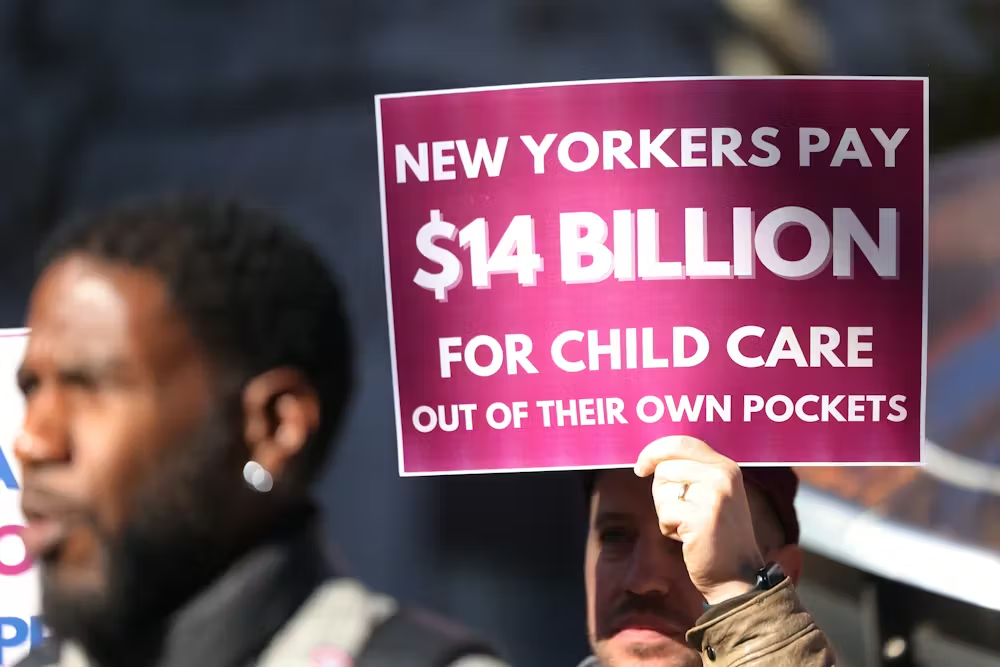
For working-class families in New York, paying for childcare often costs more than the rent on an apartment. On average, the cost of care for a single child in the city is $22,500 a year—around $1,900 per month. No wonder 80% of NYC families said they couldn’t afford it in 2024, or that new parents are forced to leave the city by the thousands.
The demand for free universal childcare for all NYC children between six weeks and five years of age was a key plank in Zohran’s platform. It’s also estimated to be the most expensive proposal on his list: $6 billion per year, according to the New York Times.
NYC already has a free pre-K program for 3–4 year olds, which costs the city $1.6 billion a year. Zohran has said he doesn’t plan to “throw everything out that came before us, [but instead] to build on that which has come before and deliver child care to those currently being pushed out of it.”
Most of the city’s current “free-K” programs are provided by a patchwork of private daycare centers with varying degrees of quality, not public school facilities. One in ten of these private providers had health and safety violations in 2022, and 2,500 children were forced onto waiting lists in 2024 due to shortages of staff and facilities.
These shortages are exacerbated by the rampant poverty wages in the industry—just $17 an hour in NYC, slightly up from a dismal $13 an hour nationally—leading to high turnover and a reduction in the childcare workforce by one third since 2020.
The capitalist market has a horrible track record when it comes to providing reliable, affordable childcare. The profit motive acts as a constant pressure to cut corners on health and safety, wages and benefits, and to increase the ratio of children to care providers. When the profit margins don’t make economic sense, these mostly mom-and-pop operations go under. Around 9,000 childcare centers have gone out of business across the country since 2019, leading to a reduction in family childcare providers across 40 states.
Within the limits of the private childcare market, Zohran’s plan faces serious obstacles. He proposes subsidizing private providers with city funds, paid for with tax measures which would require approval from the governor and state legislature. Rather than taxing the rich, Kathy Hochul prefers taxing workers or new cuts on social spending.
The pre-K program is already under intense financial pressure. Last year, Eric Adams proposed cutting $170 million, on top of $400 million in other budget cuts since 2022. Pressure to make more cuts and narrow the scope of Mamdani’s proposals will only ramp up as the city faces federal funding cuts from the Trump administration. As Hochul put it, “We also have to figure out—now I’m in the hole $3 billion already on Medicaid cuts.”
Zohran has said, “the job of city government is not to tinker around the edges.” Rather than shoring up a dysfunctional patchwork of private providers operating on poverty wages, he should outline a plan for a city-wide public program, fully staffed with union wages and quality conditions. This would need to be combined with a massive hiring push and a bold program of public works to rapidly construct as many facilities as are needed.
The bill for all this should be laid at the feet of the city’s capitalists. After all, workers generate the wealth that the billionaires squander away.