

The idea behind the iPhone seemed reasonable when it was first introduced in 2007. With one device, you could not only make calls and send text messages, but also listen to music, check maps and email, use a web browser, and take photos. It seemed like a useful, if not entirely necessary, upgrade to a standard iPod and cellphone.
If someone from that year could be transported to the present day, however, they would have to conclude that the full social consequences of modern smartphones have been rather bizarre.
College professors report that they no longer need to quiet the lecture hall at the start of the hour, since students now scroll on their phones instead of talking to each other before class starts. On any given New York subway car, perhaps 58 out of 60 people are looking at their phones the entire time. Men not uncommonly check their phones during the 20 odd seconds it takes to use the urinal, while one-third of Gen Z respondents report having texted or checked social media while having sex.
Meanwhile, activities such as reading for pleasure, hosting people at one’s house, hanging out with friends, and sleeping have all measurably declined. Attention spans have diminished, and some bourgeois commentators talk about the dawn of a “postliterate” society in which people lack the ability to comprehend complex, long-form writing. Even Literature-Humanities students at Columbia University reportedly struggle to finish a book these days. Underlying all of this, the frequency of spontaneous interactions with people we live near and work with—a feature of human existence for thousands of years—has been greatly reduced.
No one asked for this. Society at large was never consulted about whether it was a good idea. Yet it happened, because it was immensely profitable for a handful of private companies in California. This raises essential questions about how information technology functions in capitalist society, and how a genuinely democratic society—a socialist society—could actually harness it in the interests of humanity.
The Rise of Mass Literacy
Since the dawn of our species, people have found ways to communicate. But for most of that time the technological means to do so were extremely limited. Literacy emerged roughly 5,000 years ago in ancient Mesopotamia as the rise of class divisions created a need to record payments, taxes, and other economic data beyond the scope of human memory. For thousands of years, the ability to read and write was limited to a small subset of the ruling class. Couriers by horse or by foot, oral poetry, clay tablets, and later, handwritten manuscripts, were some of the dominant forms of long-distance communication in precapitalist societies. For the vast majority, however, long-distance communication simply wasn’t an option.
Capitalism in its revolutionary, progressive era changed this entirely. Arising out of decaying feudal societies in Europe, the profit-driven nature of capitalist production gave a massive stimulus to scientific innovation in the 18th and 19th centuries, necessitating widespread literacy among the upper and middle classes. Publication of books, journals, and newspapers skyrocketed in Europe. Further scientific advances led to the advent of railroads in the 1820s and, importantly, the electrical telegraph in 1837.
In turn, these “immensely facilitated means of communication,” as Marx and Engels put it, led to the accelerated development of the productive forces, allowing for much more sophisticated supply chains and networks of economic production.
In The Communist Manifesto Marx and Engels explained:
Modern industry has established the world market, for which the discovery of America paved the way. This market has given an immense development to commerce, to navigation, to communication by land. This development has, in its turn, reacted on the extension of industry; and in proportion as industry, commerce, navigation, railways extended, in the same proportion the bourgeoisie developed, increased its capital, and pushed into the background every class handed down from the Middle Ages.
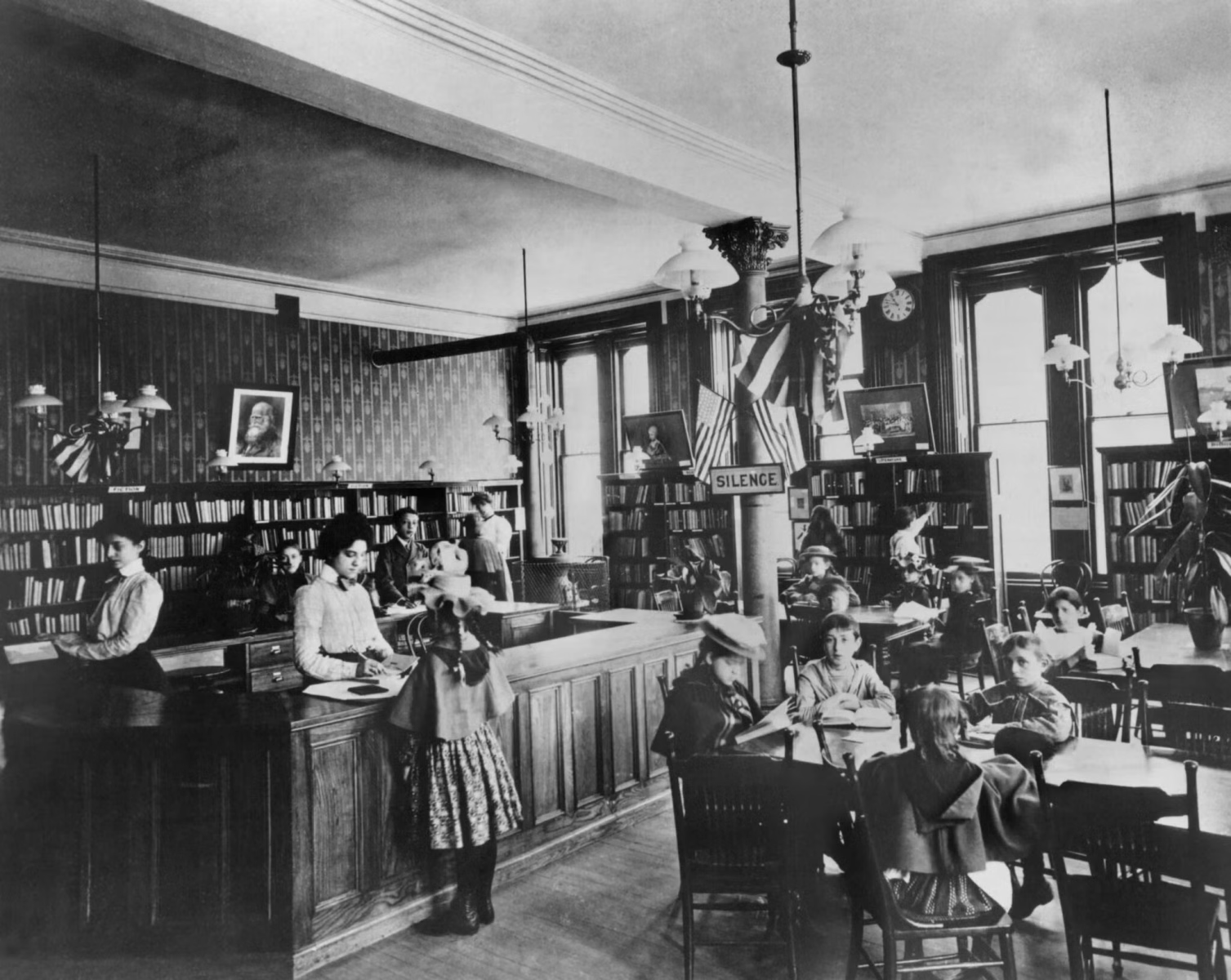
“Leisure time” also came into existence once the labor movement won gains like the weekend and the eight-hour workday, with reading becoming one of the predominant forms of leisure and entertainment at that time. / Image: public domain
This was the historically progressive era of capitalism, when it was enlarging and concentrating the previously scattered, small-scale means of production into highly efficient, large-scale industry—and creating the modern working class.
Among countless other social changes, the process of capitalist development promoted, for the first time in human history, mass literacy. As factory production became more complex and larger in scope, the ruling class increasingly had a need for literate workers who could read instructions and manuals, and perform arithmetic. In the advanced capitalist countries, this helped prompt the formation of public school systems. By 1870, 80% of the US population was literate—an astonishing development in the broad scope of human history.
All of this set the stage for the rise of mass media and modern communications networks. Mass literacy created a new consumer market for books, newspapers, and magazines. “Leisure time” also came into existence once the labor movement won gains like the weekend and the eight-hour workday, with reading becoming one of the predominant forms of leisure and entertainment at that time.
The average number of books published in the US each year rose from 2,000 in 1880 to 11,300 in 1940. Subscriptions to newspapers and magazines also grew massively. Even relatively poor households often subscribed to multiple daily newspapers. The capitalist class had facilitated mass literacy and developed communications technologies for their own purposes, but as a consequence, ordinary people could now start to access the world of culture.
From the radio to modern smartphones
By the early 20th century, however, capitalism’s historically progressive role was exhausted. The very system that had previously served to consolidate and develop the means of production was now senile. A historic crisis of overproduction weighed on the world economy. The impasse of world capitalism led to the outbreak of World War I in 1914. With nowhere else to expand, the European imperialist powers sought to make incursions into “each other’s” markets and territories.
In the midst of this historic crisis, the Russian working class, led by the Bolshevik Party, succeeded in overthrowing capitalism and establishing the world’s first workers’ government.
The immediate task facing the Russian workers’ state was to fend off counterrevolution and develop the economy as quickly as possible, while fighting to extend the revolution into Western Europe and America. As an integral part of this endeavor, Lenin and Trotsky both took a keen interest in improving the technological level of Soviet Russia.
In his 1926 speech “Radio, Science, Technique, and Technology,” delivered in the USSR, Trotsky summarized the technological revolutions that had taken place over the previous 25 years:
In the course of this quarter-century more than one revolution has taken place, though on a smaller scale than ours, in a whole series of countries. In 25 years life has been invaded by the motorcar, the aeroplane, the gramophone, the cinema, radio-telegraphy and radio-telephony. If you remember only the fact that, according to the hypothetical calculations of scholars, not less than 250,000 years were needed for man to pass from a simple hunter’s way of life to stock-breeding, this little fragment of time, 25 years, appears as a mere nothing. What does this fragment of time show us? That technique has entered a new phase, that its rate of development is getting continually faster and faster.
To Lenin and Trotsky, these new technologies were not merely innovations to marvel at, but crucial building blocks for constructing a socialist society of superabundance. Backwards Russian capitalism had only small concentrations of industry before the working class took power in 1917, and the Bolsheviks continually stressed the urgent need to catch up.

“We cannot seriously talk about socialism without having in mind the transformation of the country into a single whole, linked together by means of all kinds of communications.” / Image: public domain
As Lenin famously asserted in 1920: “Communism is Soviet power plus the electrification of the whole country, since industry cannot be developed without electrification.”
Trotsky emphasized the point in his 1926 speech: “We cannot seriously talk about socialism without having in mind the transformation of the country into a single whole, linked together by means of all kinds of communications.”
While it was limited by the low level of economic development that the Soviet Union inherited from tsarist Russia, the USSR’s planned economy marked the first time in history that these modern industrial technologies were being harnessed as part of a rational economic plan to meet human need, rather than an anarchic, profit-driven market economy.
Lenin and Trotsky had predicted that the socialist revolution would spread from Russia into Western Europe, allowing Soviet Russia and a United Socialist Europe to link up their economies and harness their shared industry and technology for the purpose of building socialism.
If the working class had taken political power across Europe and in North America at that time, then-new technologies such as radio and cinema, as well as future technologies such as television and the internet, would have been developed and integrated into daily life as part of a democratically planned economy, in the interests of human culture and wellbeing.
However, due to the defeats of the proletarian revolutions in surrounding European countries, the Russian Revolution remained isolated throughout the 1930s and 1940s, with the state apparatus degenerating into a Stalinist bureaucracy. Meanwhile, Western capitalism managed to temporarily stabilize itself after World War II.
As a result, the means of communication and related personal technologies continued to develop on a for-profit, capitalist basis. Household telephones, televisions and record players, and later VHS, CDs, and DVDs were introduced in a similar manner to radio and newspapers before them. Personal computers, cell phones, and the modern internet emerged in the 1980s and 1990s, culminating in the development of the “smartphone” in the late 2000s.
Distorted development
Considered in the abstract, all of these technologies are triumphs of human civilization. Billions of people worldwide now have instantaneous access to virtually all the world’s information. The collected works of the greatest thinkers in history are, theoretically, at everyone’s fingertips, not to mention incredibly detailed maps. In this sense, these technologies are the kinds of innovations that Marx and Engels had in mind when they wrote that the bourgeoisie had “accomplished wonders far surpassing Egyptian pyramids, Roman aqueducts, and Gothic cathedrals.”
Yet, in practice, the ubiquity of internet-enabled smartphones has clearly not led to a society of greater literacy, culture, and human connection. Due to the belated nature of the socialist revolution, the implementation of this technology had a highly distorted, contradictory character, often atomizing society even further, serving to lower the cultural and literacy level of millions.
Technology designed for the purpose of enriching human life would tend to facilitate engagement with high-quality cultural material and entertainment, as well as in-person interactions with other people. Personal technology under capitalism does the opposite, as the primary driving force is the accumulation of profits, not human wellbeing.
Already in the 1950s, American TV networks were preoccupied with maintaining “audience flow,” in which viewers continued to watch program after program, so as to maximize ad revenue. In more recent times, we have seen that the most profitable business model for social media companies is to maximize the time users spend on each platform—also to maximize ad revenue. Weaponizing behavioral psychology for the sake of profits, they introduced features such as “likes” and algorithmically curated feeds with “infinite scroll” in order to keep people glued to apps for as long as possible.
Compare this to the way the USSR harnessed novel consumer technologies. From the 1920s onwards, the Soviet Union built “houses of culture” in hundreds of cities and towns. These were large community centers with cinemas, lecture halls, concert halls, dance studios, libraries, and meeting rooms that were free or highly subsidized. Ordinary workers who wanted to learn about things like classical music or chess or literature or science had ample means to do so.

It is hard to imagine “houses of culture” being built across capitalist America, or a television industry that prioritizes the health of the audience over viewing time. / Image: public domain
The American philosopher John Dewey described his visit to an early Soviet “house of culture” in 1928:
Here was a fine new building in the factory quarter, surrounded by recreation grounds, provided with one large theater, four smaller assembly halls, 50 rooms for club meetings, recreation and games, headquarters for trade unions, costing two million dollars, frequented daily—or rather, nightly—by 5,000 persons as a daily average. Built and controlled, perhaps, by the government? No, but by the voluntary efforts of the trade unions, who tax themselves 2% of their wages to afford their collective life these facilities. The House is staffed and managed by its own elected officers. The contrast with the comparative inactivity of our own working men and with the quasi-philanthropic quality of similar enterprises in my own country left a painful impression. It is true that this House—there is already another similar one in Leningrad—has no intrinsic and necessary connection with communistic theory and practice. The like of it might exist in any large modern industrial center. But there is the fact that the like of it does not exist in the other and more highly developed industrial centers. There it is in Leningrad, as it is not there in Chicago or New York.
Even under the suffocating Stalinist bureaucracy, this general attitude toward mass culture continued when household television was introduced in the USSR. In a 1965 report, Soviet television researchers criticized American broadcasters for aiming simply to “glue as many people as possible to their televisions and radios.” Soviet television, they argued, should be engaging but also intellectually stimulating, appealing to certain groups of people based on their interests and needs, rather than aiming for the largest possible audiences and longest viewing times.
Anatolii Bogomolov, head of the Soviet Central Television programming desk, even published an article titled “Watch Less Television” in 1967, responding to criticisms that Soviet television was not entertaining enough:
We get letters surprisingly similar to those of the critics: “Yesterday I watched all evening and nothing good was on.” It’s hard not to answer, “Do not spend the whole evening in front of the TV! Watch one or two programs, a broadcast of television news, and then go read or take a walk.”
It is hard to imagine “houses of culture” being built across capitalist America, or a television industry that prioritizes the health of the audience over viewing time. Instead, the general tendency in capitalist society over the decades has been for people to spend more and more time at home, consuming electronic entertainment in solitude. TV and social media were designed, above all, to maximize profits, not to improve life.
When personal televisions became widespread in American households in the 1950s, people started to socialize and read less often. Now that smartphones have become near universal—as of 2026, 97% of the US adult population under 50 owns one—there has been a further decline in all kinds of healthy behaviors: not only socializing and reading, but also things like outdoor play among children, sleep duration, having hobbies, and spending time alone with one’s thoughts. While smartphones aren’t the only factor at play, their proliferation has clearly accentuated these trends.
A recent article in The Atlantic titled “The End of Reading Is Here” compiled some sobering data:
A study analyzing 236,000 responses to the American Time Use Survey found that the proportion of Americans who read for pleasure on any given day fell from 28% in 2004 to 16% in 2023. (The study looked at people who had read a book, magazine, or newspaper; listened to an audiobook; or read an e-book.)
And as another article in The Atlantic explained in 2025:
The typical person is awake for about 900 minutes a day. American kids and teenagers spend, on average, about 270 minutes on weekdays and 380 minutes on weekends gazing into their screens, according to the Digital Parenthood Initiative. By this account, screens occupy more than 30% of their waking life …
More worrisome than what young people do on their phone is what they aren’t doing. Young people are less likely than in previous decades to get their driver’s license, or to go on a date, or to have more than one close friend, or even to hang out with their friends at all. The share of boys and girls who say they meet up with friends almost daily outside school hours has declined by nearly 50% since the early 1990s, with the sharpest downturn occurring in the 2010s.
Marxists are not “opposed” to personal technologies as such, and do not approach this topic moralistically, but it would be hard to argue that these changes are benign.
The need for a socialist plan of production
We have seen that the general tendency over the past century has been an increasing sophistication of the means of communication, and with it, continuous changes in the nature of leisure time, socialization, entertainment, and exchange of information. In a genuinely democratic society, each new innovation would have opened up a public debate over how best to implement and utilize the new technologies.
In his 1934 article “If America Should Go Communist,” Trotsky gave examples of the way in which new technologies could be debated and implemented under a system of workers’ democracy:
The American soviets [workers’ councils] will be full-blooded and vigorous … A wide struggle between interests, groups, and ideas is not only conceivable—it is inevitable. One-year, five-year, ten-year plans of business development; schemes for national education; construction of new basic lines of transportation; the transformation of the farms; the program for improving the technological and cultural equipment of Latin America; a program for stratospheric communication … all of these will arouse controversy, vigorous electoral struggle, and passionate debate in the newspapers and at public meetings.
While his examples are somewhat specific to the 1930s, he also pointed out that a socialist government would have to democratically develop new ways to harness information technology for the benefit of society as a whole:
Soviet America will not imitate the monopoly of the press by the heads of Soviet Russia’s bureaucracy. While Soviet America would nationalize all printing plants, paper mills, and means of distribution, this would be a purely negative measure. It would simply mean that private capital will no longer be allowed to decide what publications should be established, whether they should be progressive or reactionary, “wet” or “dry,” puritanical or pornographic. Soviet America will have to find a new solution for the question of how the power of the press is to function in a socialist regime.
One can certainly imagine that, had the internet and modern computing technologies emerged in a socialist society, a lively society-wide debate could have carefully weighed how to design and employ these new tools to serve human wellbeing. Should the internet rely on a handful of monopolized algorithmic feeds to distribute information, or use a more decentralized exchange of “word-of-mouth” recommendations? Should everyone be required to carry smartphones? Or should we make them available for those who want one, while also equipping cities with free and easily accessible digital devices, maps, phones, etc. for use when needed? Should we prioritize making streaming content more available, or focus on building democratically run public cinemas, concert venues, and lecture programs?
But these questions were never asked. Throughout the history of capitalism, the introduction of personal technologies was motivated, first and foremost, by the simple need to sell as many radios, televisions, personal computers, and smartphones as possible, and later, the need to collect as much user data as possible. The result of this blind, profit-driven economic development is a society that is more alienated than ever, with declining functional literacy, a proliferation of “AI slop,” and all the other mind-numbing features of our technological era.
It’s no wonder that 60% of Gen Z adults say they wish they could return to a time before everyone was “plugged in,” while fully 91% of 18–34-year-olds are trying to limit their screen time. Individual efforts can have a modest impact—in fact, they are arguably essential for anyone who seeks to make a serious study of Marxism, or accomplish any other intellectual endeavor while living under capitalism—but as long as the profit motive remains, it will always be an uphill battle.
Faced with such a bleak scenario, many have turned against “technology” in the abstract. But it doesn’t have to be this way. On the basis of a socialist revolution, liberated humanity can finally harness technology in a conscious and democratic manner, as part of a rational economic plan made in the interests of society as a whole.
Given the high technological level of the US, the ability of a workers’ government to spread access to culture would dwarf the achievements of the Soviet Union. With a workweek of 20 hours or less, everyone will finally have the necessary time to pursue their interests. The cheapening of information technology and the overall development of the economy will not decrease, but rather increase, the number of public cinemas, cafes, libraries, bookstores, parks, bars, concert halls, gymnasiums, etc. The collective dreams, pursuits, and interests of billions of people, trampled upon by capitalism in a thousand ways, will finally find expression, opening up a new era for human culture.
As Engels put it in Anti-Dühring:
Man’s own social organization, hitherto confronting him as a necessity imposed by nature and history, now becomes the result of his own free action. The extraneous objective forces that have hitherto governed history pass under the control of man himself. Only from that time will man himself, with full consciousness, make his own history—only from that time will the social causes set in movement by him have, in the main and in a constantly growing measure, the results intended by him. It is humanity’s leap from the kingdom of necessity to the kingdom of freedom.